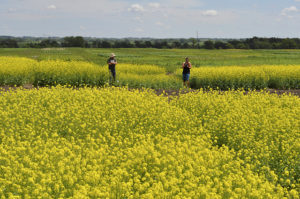
Thanks to Friends of Family Farmers for this guest blog post explaining the history of why unregulated canola production is a threat to specialty crop and organic seed growers. The Oregon Department of Agriculture is currently accepting public comments on its Willamette Valley canola rule. The comment period ends June 21, 2019. Learn more and get involved here.
Background
The Willamette Valley is known worldwide for producing high-quality vegetable and cover crop seed. Farmers and gardeners around the world rely on Willamette Valley seed producers to maintain a well-organized system of isolation distances and crop rotations to ensure seed purity so that the seeds you plant match the pictures on the seed packs you buy.
Many of the seeds grown in the Willamette Valley are food crops in the Brassica family, such as broccoli, kale, cabbages, bok choi, mustard greens, radishes, turnips, and more. Canola (also called rapeseed) is in the same family, but is primarily grown for oil production, not to be sold as seed for planting. Canola can also spread many of the same plant diseases that impact other Brassica crops. Internationally, in regions where commodity-scale canola production has taken hold, specialty seed production has declined or withered away.
Furthermore, due to its ability to move away from fields where it was planted from one year to the next, canola can also contaminate a variety of cover crops grown for seed in the Willamette Valley, and can spread into public rights of way where it is difficult to control. Unlike other Brassicas, most of the commercially available canola varieties are genetically engineered (GE) for herbicide tolerance, making concerns over cross-pollination and weediness even more concerning for many farmers, especially organic seed growers.
In the Willamette Valley, the specialty seed and cover crop seed industries consist of dozens of seed companies and hundreds of farmers – both organic and conventional – whose seeds are sold locally and worldwide to farmers and gardeners alike. These industries now at risk from canola exceed well over $100 million in production value each year.
Because of canola’s well documented plant disease and cross-pollination issues, it has been heavily regulated in the Willamette Valley for decades, and was effectively banned completely for many years. Due to pressure to plant canola in the Willamette Valley for biofuels beginning in the mid-2000s, research was conducted to determine whether it could co-exist with other Brassica crops. In 2013, legislation was passed to allow 500 acres per year of canola for research purposes. By agreement, only non-GE varieties were grown during this time and only in accordance with specialty seed isolation rules which require a three-mile distance between fields of similar Brassica crops that can cross-pollinate. These limits on canola acreage and isolation distances expire July 1, 2019.
Ultimately, the research did not reveal any new information on canola that would suggest that it should be unregulated in the Willamette Valley. Further, the research did not address the unique risks and problems associated with growing GE, herbicide-resistant varieties of canola. Following the research, recommendations from the Oregon Department of Agriculture (ODA) on future management of canola included proposals like creating an Isolation Area where no canola would be allowed, to maintaining the status quo of capping annual acres at 500 while requiring mandatory isolation distances to protect specialty seed crops.
Take action
In response, the Oregon Legislature is now considering a bill, SB 885, to maintain the 500-acre cap on canola indefinitely, and ODA has proposed a new canola rule to replace the expiring rules as described above.
The harmful risk of unregulated oilseed canola production in the Willamette Valley is once again facing Oregon farmers and food consumers. Current rules that cap annual canola production at 500 acres in the Willamette Valley expire on July 1. Now, both the ODA and the legislature are considering new measures to address the risks from canola production to the region’s world renowned specialty seed industry after July 1.
SB 885 has passed one key committee and is now awaiting action in the Ways and Means Committee.
Meanwhile, the ODA has announced a newly proposed rule to replace current expiring canola restrictions. Unfortunately, ODA’s draft proposal simply falls short of what is necessary to protect the unique attributes of the Willamette Valley’s specialty seed industry. ODA’s proposal includes no acreage cap, doesn’t explicitly prohibit canola production in a proposed Isolation Area, doesn’t prohibit herbicide tolerant or genetically engineered canola varieties, and leaves large parts of the Willamette Valley unprotected.
Do you live in Oregon? Tell ODA that their protections for organic seed producers must be stronger. Take action today.