Organic farmers need spinach varieties that not only have good disease resistance and stress tolerance but also produce good yields of high quality organic seed. To inform future organic spinach breeding efforts Organic Seed Alliance at the Washington Research Farm continues collaborating on the Systems Approach to Maximize Organic Spinach Productivity project. The project is supported by an Organic Research and Extension Initiative (OREI) grant through the USDA National Institute of Food and Agriculture. The project team comprises Vijay Joshi at Texas A&M, Ainong Shi and Gehendra Bhattarai at the University of Arkansas, Alice Formiga with the eOrganic project at Oregon State University, Micaela Colley, Kayla Ierlan, and Susana Cabera-Mariz at Organic Seed Alliance. The Washington-based Organic Seed Alliance research farm is in an ideal spinach production providing the opportunity to analyze seed production qualities of potential breeding lines and cultivars.
This multidimensional project seeks to understand the role of soil microbes in the nutritional content of spinach. Additionally, the project aims to understand nitrogen use efficiency and its correlation with abiotic stress factors. This year, Organic Seed Alliance is analyzing 306 spinach accessions for seed yield potential and resilience in response to abiotic stress factors. While analyzing a diverse set of varieties from the USDA-ARS Germplasm Resources Information Network (GRIN) seed collection, Organic Seed Alliance is also trialing standard and stable varieties as a reference point to the 306 GRIN accessions. The information from this study will assist organic spinach breeders and farmers in making selection decisions and make GRIN accession data more available and robust. Project results, resources. and educational opportunities related to the project can be found on the eOrganic project website.
Thus far, Organic Seed Alliance has identified accessions that respond to abiotic stress factors like heat. In year one, 19% of the accessions bolted before being planted due to an early heatwave. According to Kayla Ierlan, the main takeaway from last year’s trial was that “transplanting rather than direct sowing added additional stress on the plants causing them to bolt before maturity.” Spinach favors cool to moderate growing temperatures (below 75 degrees Fahrenheit) and a day length of 13-15 hours. When introduced to higher temperatures seed yield and quality can be compromised. Accessions PI 699741 (New York, U.S.), PI 699746 (Pennsylvania, U.S.), PI 699761 (Oregon, U.S.) were identified as the slowest to bolt, they started to bolt at the beginning of June much later than the majority of varieties. It is worth noting, that these accessions have previously been selected for blight resistance.
Additionally, the team determined that accessions PI 176770 (Erzincan, Turkey), PI 176371 (Italy), and PI 176770 (Turkey) were the highest seed producers. According to Kayla Ierlan, OSA Farm Manager, “No correlation was found between leaf type, wildness, and amount of seed produced. This finding came as a surprise since one could assume that varieties that have been bred for production would have higher seed yield rates than their wild counterparts.” This year’s data will go a long way towards determining average seed yields and any correlation with other characteristics.
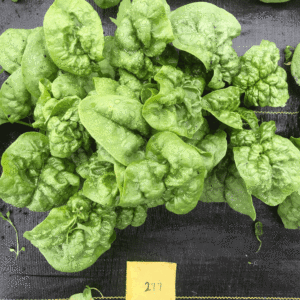
The OSA team is excited to jump back into research, this year spinach was sown in early April and bolting data collection is underway. In contrast to last year, the spinach was directly sown which has had a positive effect on the viability of seed production. This spring, the research team has had more time to assess the various phenotypes. The four classes that are primarily determined by leaf texture are Savoy which has deep creases running their length (Ex. Bloomsdale), Flat-Leaf which is often favored for their ability to be easily cleaned and shipped (Ex. Viroflay), and Semi-Savoy whose characteristics fall between the Savoy and Flat-Leaf (Giant Winter), and Arrowhead whose leaves are shaped like Sorel or an arrowhead. In addition to these types, several wild varieties are on show this summer at the OSA research farm, notable examples are PI 648961 (Savoy), PI 699753, Semi Savoy, PI 604780, Arrowhead and PI 419004, Flat leaf (pictured below). As pictured, some varieties have unique textures and colors and show the beauty and diversity of spinach. Stay tuned for our Winter Newsletter to learn more about the project results!