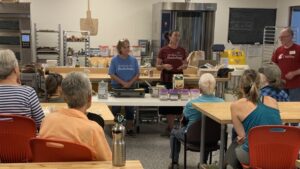
“Look, I am not going to tell you numbers, but what I can tell you is that my farm pays the bills, for the trucks, the machinery, the people . . .” said Bouchard Family Farms owner Joe Bouchard, smiling when I asked if his buckwheat operation in Maine was profitable. Next to him, his wife, Mrs. Janice Bouchard, cooked some buckwheat and wheat pancakes on a hot plate. They shared the pancakes with the thirty-plus people who listened attentively to their presentation at this year’s Buckwheat Festival, held at Washington State University’s BreadLab in Burlington, WA.
During the presentation, Mr. Joe emphasized how the buckwheat business allowed him to make farming viable for his family and continue a six-generation farming enterprise. “Buckwheat is a very resilient crop; it requires very little water, very little inputs, and is very abundant . . . It also has a very good niche market in the gluten-free community”. Throughout the presentation, many audience members sat in awe, understanding this non-traditional commodity crop’s importance to the economic and environmental sustainability of our country’s agricultural industry.
“Many years ago, my father asked me to go to our neighbors’ farms, asking for buckwheat seed. I did it once, and that’s all. Never again. I produced all the seed needed,” said Mr. Joe when asked how he sourced the buckwheat seed for his operation. His statement illustrated buckwheat’s potential in promoting autonomy and sustainability for those producing it.
Some hours before, Dr. Micaela Colley, a WSU researcher and plant breeder focusing on buckwheat, gave a presentation in a WSU demonstration field. We were guided through a very impressive dry-farmed plot of buckwheat varieties from countries around the world. “We had access to these seeds through the USDA program GRIN,” noted Dr. Micaela. Then someone added, “Programs such as the USDA GRIN are in some danger because of government budget cuts.” The audience seemed concerned by that remark.
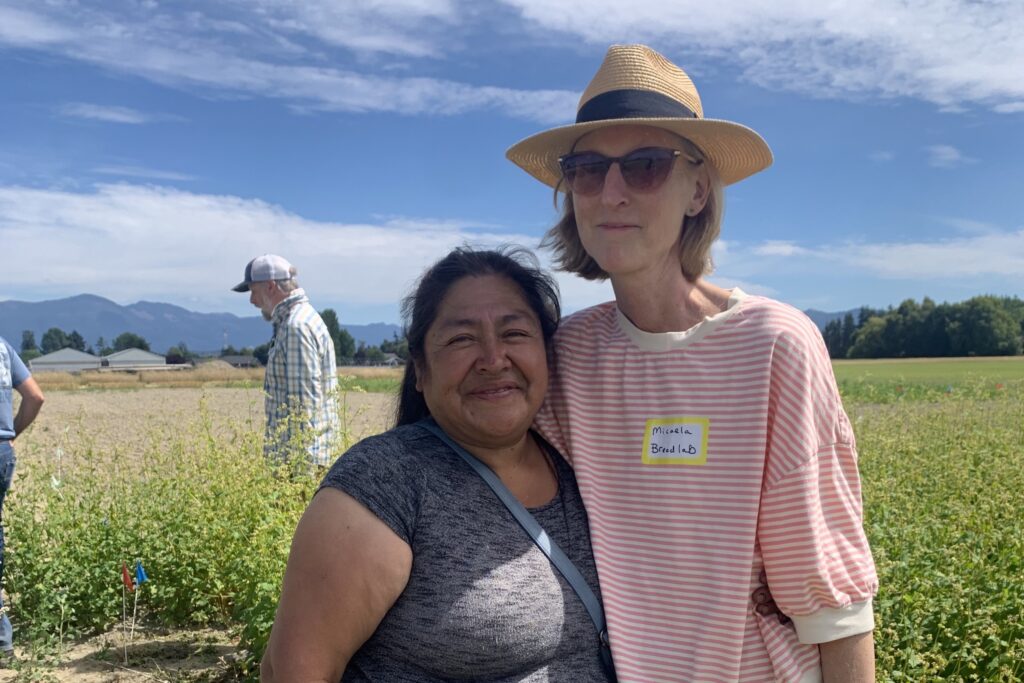
Nelida Martinez (left) from Pure Nelida Organic Produce, and Micaela Colley (right), WSU Plant Breeder and Researcher. In the background: a plot of dry-farmed buckwheat.
These conversations I witnessed brought a sweet and sour feeling. On one hand, people from various backgrounds, including plant breeders, farmers, NGO workers, food entrepreneurs, and researchers, were celebrating and praising the role of non-conventional crops in food security and the economic viability of farming. On the other hand, many discussed how funding cuts for research and other activities could endanger the full realization of those potentials.
Beyond this, the afternoon was full of good conversations, delicious food featuring the culinary gift of buckwheat cooked by people from different cultural backgrounds, and, more than anything, a celebration of the unifying potential of food itself. In times of change in climatic patterns, here in Washington state, there are fields of a dry-farmed crop, full of potential to feed people, promote economic growth, and support rural economies. That gives me hope. Really looking forward to the 4th Buckwheat Festival— hope to see you then!