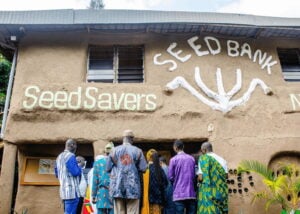
We are thrilled for our partners at Seed Savers Kenya Network, Kenya, for their national win in the recent High Court judgement to protect farmers’ rights to seed. The Network filed a lawsuit in 2022 that challenged the Seed and Plant Varieties Act, which would have criminalized sharing indigenous seed by up to two years in prison or a fine or KSh 1,000,000 (~$7800 USD) or both. Because of their bravery, foresight and action, Kenyan farmers remain free to save, share and exchange indigenous seeds without the fear of persecution. Congratulations to Daniel Wanjama and the whole network for this historic win! Read an analysis of the legal framework and its impact on farmers’ rights on the Seed Savers Network website. and check out our guest article on this historic decision by Mercy Kariuki-McGee of Haki Farmers Collective below.
Not a Crime to Save and Share Seeds, a Landmark Victory for Seed Keepers in Kenya
Authored by guest contributor Mercy Kariuki-McGee of Haki Farmers Collective
On November 27th, 2025, a High Court in Kenya ruled in favor of smallholder farmers. The lawsuit was filed by farmers from the Seed Savers Network Kenya. The Case was supported by Greenpeace Africa, the Law Society of Kenya, and the Biodiversity and Biosafe Association of Kenya. The argument was based on the fact that the Kenyan government was violating its own constitution, especially Article II (2) (b,) which is intended to promote and protect the intellectual property of the Kenyans and further allows the parliament to enact legislation that recognises and protects the Indigenous seed and plant variety, the genetic disbursement and uses by communities in Kenya.
The ruling declared sections of the Seed and Plant Variety Act (Cap 326) to be unconstitutional and in violation of the International Treaty on Plant Genetic Resources for Food and Agriculture. The ruling decriminalised the generational practice of saving, sharing, and exchanging of Indigenous seeds that have been passed on. Asserting that farmer-managed seed systems are protected under the Kenyan Constitution and should not be a crime. The Parliament of Kenya enacted the Seed and Variety Plant Act in 1972 and has since undergone various revisions, the 2022 revision of which raised concerns and resulted in the case referenced in this landmark victory. The proposed law stipulated that anyone selling seed that violates any provision is committing an offence and faces a fine of up to one million shillings (about $7,500 USD) or imprisonment of up to two years (CAP 326:10:4). This is a hefty price to pay for losing intellectual rights and ownership of family seed. Most small-scale farmers in Kenya grow food for their families and, in some cases, sell it in markets and to other intermediaries. Prohibiting seed sharing would have created a major roadblock to how communities access food.
Farmers, communities, and activists are hailing this a landmark decision as a win for all of us that should drive other communities to protect their Indigenous knowledge and intellectual rights to own, save and share their seeds without being bound by government. Big seed companies are pushing to patent seeds, taking away intellectual rights and interfering with food sovereignty and how communities grow and access food.
Communities across Africa rely on Indigenous knowledge passed from one generation to the next, so we can continue to protect seed, steward the land properly, and feed our families with healthy food. Farmers choose how the seeds are saved and shared, we grow food for the people, not corporations. Food sovereignty should not have a price tag on it; it is how communities support their livelihood. This is what it should be: a global win for all farmers, and they should be the keepers, not corporations.
Farmers’ reactions were clear that the Act was not going to help shape the future of their farming and food access. This is what they had to say:
“I can’t afford seeds from the shop, they are too expensive. We have our traditional way of preserving seeds from one generation to the next,” – Rural farmer in Mlindi
“Seed saving and sharing is part of our tradition. I select the healthiest seeds from my harvest and plant them the next season. My seeds are resilient and well acclimated to my weather. They do very well here; they need less water than those they sell in the store, which they call “certified seeds. My parents taught me, and they learned from their parents, all the way back to our forefathers. I am now teaching my children the same” – farmer in Kandara County
Food sovereignty begins with a seed, and it is that seed that we are fighting for. It is a clear indication on how western countries continue to influence decisions in “developing” countries, which in most cases is tied to funding and spending budgets that are wholly financed by the western nations. Africa is then tied to stipulations that either take away their rights or, in some cases, cannot be met. This influence is seen through the introduction of legislation and laws that are not vetted by the people. These particular pieces of legislation went through several enactments: 2002, 2012, 2016, and the recent proposed revision in 2025. Understanding it is important to note the significance of the 2012 amendment in particular, which added several contentious sections that fundamentally undermined farmers’ rights. The results of which were adopted in the 2011 Seed and Plant Varieties Amendment Bill, enacted on January 4th, 2013. The provisions in the amendments were aligned with UPOV 1991 (Act of the International Convention for the Protection of New Plant Breeders’ Varieties of Plants). In compliance with UPOV 1991, which emphasises intellectual property rights, plant breeders’ rights, and plant variety protections. This principle is known to prioritise commercial breeders and favors the interests of multinational corporations over smallholder farmers. The evolution of this lawsuit created further alteration of the influence on the Seed and Plant Varieties Act of 2012, laying down procedures for the performance evaluation of new plant varieties for various agro-ecological zones in Kenya.
The fight for food sovereignty is for all of us to fight. In this article from grain.org, written in 1994, featuring Hope from Rural Advancement Foundation International (RAFI) notes how UPOV 1991 has pushed its agenda to vulnerable countries.
“As [we] go to press, the Clinton Administration is about to sign a bill amending the 1970 Plant Variety Protection Act. The bill, which just passed through Congress, will make it illegal for American farmers to save and sell seeds from proprietary crop varieties without permission from breeders and the payment of a royalty. It is also the precondition for the US to ratify the new UPOV Convention, as revised in 1991. Industry’s ruthless campaign against farmers’ rights to freely save seed in the United States, and the tough struggle NGOs and farming families are caught in to defend diversity in the American seed economy, is best exemplified by the now-famous ‘Winterboer’ case. We asked Ms. Hope Shand of RAFI (Rural Advancement Foundation International) to report on these battles from home. RAFI has been working vigorously to defend farmers’ rights in the US in concert with farmer organisations, grassroots seed saving programs and environmental groups.”
“Now that the United States is about to become the first nation to ratify UPOV 1991, there will be growing pressure for other countries to follow the lead in adopting UPOV 1991. Will UPOV 1991 become the new standard pushed by the industrialised North as the effective sui generis system for protection of plant varieties as mandated by GATT/TRIPs? The U.S. precedent in ratifying UPOV 1991 signals the urgency for other governments to develop alternative sui generis national legislation that is both pro-farmer and pro-diversity.”
Special thanks to Mercy Kariuki-McGee of Haki Farmers Collective for this article.