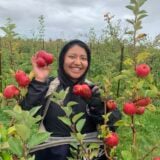
In the fall of 2025, Nancy Castellanos interned at Organic Seed Alliance (OSA) through the Organic Career Networks (OCN) internship program. The Organic Career Network collaborates with colleges, nonprofits, farms, and organizations across the country to make organic careers more accessible, inclusive, and visible. Nancy’s internship focused on exploring social science research within the context of the organic agriculture industry. Through mentorship and staff support, Nancy co-developed and performed a pilot study. In the ethnographic narrative below, Nancy explores the intricacies of organic agriculture through the perspectives of two farmers. Through these interviews, Castellanos highlights both industry challenges and opportunities for growth.
During my internship with Organic Seed Alliance, I wanted to know whether minority farmers knew about the organic seed production industry and what the barriers to entry were. I developed a pilot research study based on ethnographic research methodologies to answer these questions. My hypothesis was that there were language, financial, land access, and knowledge barriers that restrict minority participation within the organic seed production industry. With my research idea in hand, I learned about ethnographic research methods, developed research questions, consent forms, and a thoughtful research protocol.
Through the help of a colleague at Triumph Teen Life Center’s Café con Pan program, I was connected to 13 Skagit County farmers they purchase food from. Café con Pan is a space where community, culture, and care come together. Once a month, they host an informational session for registered families, providing access to valuable resources, community updates, and support services. Alongside this, families receive fresh, locally sourced organic produce grown by BIPOC farmers, helping promote both health equity and economic support for diverse agricultural communities. Through the assistance of Café con Pan, I was able to recruit two farmers to participate in my pilot study. With my research plan in place, I set off to meet the farmers and tour their farms.
Minority farmers have slowly started their own farms; A big step from working in the fields to becoming farm owners. My interviews showed vast differences in the experience of farmers within the organic industry. One successful organic blueberry owner and another who hasn’t had the best luck when it comes to organic production. Rather than teaching them about the organic seed industry, I was the one who ended up learning a few things and having my research hypothesis confirmed.
Learning about Organic Certification
Silva Family Farm is an organic berry-producing farm run by husband and wife, Pablo and Maura Silva. They grow blueberries and strawberries. I spoke to the wife, Maura Silva. She told me the story of how they got started. She moved to Skagit County at the age of 14. Like most immigrant parents, her first job was working in the farm fields across the West Coast, wherever the season took her. She eventually settled in Mount Vernon with her husband. They worked at Sakuma Brothers for a long time, where Pablo was a pesticide sprayer. Eventually he began to feel sick, and he realized that the pesticides were causing his sickness. The pesticides were taking effect on his body. Pablo decided he didn’t want to expose himself to that, nor did he want to expose his family. Shortly after, a new opportunity presented itself; an organic blueberry farm needed a farm manager.
The owner of Bow Hill Blueberries knew all about organic certification, but he lacked technical expertise in blueberry production. Pablo was the perfect man for the job; he knew how to prune, grow, maintain, and care for blueberry plants. Bowhill’s owner started taking him to meetings and events, which helped Pablo learn business management skills. After some time and coaching, Bowhill told Pablo that he had what it took to start his own business. Pablo and his wife considered it but didn’t know where to begin.
In the meantime, a friend of Bowhill mentioned that she needed help on her farm. She had just bought a new house that had small blueberry plants. The plants weren’t producing as well as she’d like, so she needed help caring for them. Bowhill sent Pablo and his family to help with her blueberries. Tragedy struck this friend, and she moved away to Eastern Washington to care for her father’s 200+ acre orchards. She left the blueberry field to Silva Farms. It took some time before the Silva family accepted the home and the field, but they eventually did. The Silva Family now cares for three acres of blueberries and two acres of strawberries; additionally, they have a farm stand in Oak Harbor and sell at the Skagit Food Co-op.
Challenges of organic agriculture
Monte Farms is a natural grower. They started off as certified organic but soon found that being organic in Skagit County was far too competitive. When they first started off, they had over 20 acres of land they were farming on. They were participating in various programs that offered aid to new farm businesses. Quickly, they realized that their ideals weren’t in alignment with the aid programs they participate in.
Monte Farms believes that aid programs receive millions of dollars through grants, donations, and equipment, but the actual aid to farmers is limited. They shared an example of how this dynamic has negatively affected their business. A tool donation was made to a local aid program; farmers were then charged to borrow the donated equipment – making it cost-prohibitive. Monte Farms noted that this donation surely was meant to help farmers, not create another barrier to success.
After successive similar experiences, Monte Farms decided they did not want to be a part of the organic industry. Now Monte Farms grows things as organically as possible; they consider themselves “natural.” To Monte Farms, this means no chemicals in the fields. Although Monte Farms is not certified organic, they experience the agronomic and personal benefit of using natural practices.
Interview Insights
After talking to these farmers, my hypothesis of language being a barrier to organic production was reinforced. I knew that there was little to no information on organic policies, grants, and certifications that were translated to Spanish. As a child of migrant parents, I translated from a young age. There were times that I could not find the Spanish translation for the English word, so I would describe it the best I could. I knew my parents still had a hard time understanding.I also heard from these farmers that they too have their children translate for them. One participant mentioned that Spanish was their second language and they had a hard time understanding Spanish. They voiced wanting to learn to write and read in Spanish. Many agriculturalists speak Mixteco Triqui, Zapoteco, and Tzotzil and are semi-fluent and learning Spanish and English as third and fourth languages. These conversations helped me realize that the organic agriculture industry lacks language skills.
This lights a fire within me. I want to teach all of them and cater to their needs, but I know deep down that it’s not easy to say “Yes, we can make that happen.” I am passionate about sharing information. I want to help farmers to get the resources that they need to be successful. I want to give these farmers the resources that any fluent English speaker has. The first step to making this happen is making sure to hear their voices, know what their needs are, and come up with a long-term plan to make a change.
At the end of the internship, I was hired by the Rodale Institute to provide these services. I will be working with the community to provide the resources for those transitioning to organic. I will be doing farm visits, attending conferences and webinars, making connections with those in my community, and finding resources that these farmers need. I may be romanticizing this new position, but knowing that I can be someone for Hispanic farmers to connect with brings me joy. I enjoy seeing doctors, nurses, cashiers, and other people I encounter speak to me in my first language, Spanish. Although I am fluent in English, there is a special connection and sense of understanding that speaking my native language brings me.